
Routt County Arrest Records and Court Charges
Arrest records in Routt County may begin with a sheriff, police, or detention record. The Routt County Detention Center is the central holding facility for law-enforcement agencies in the county, including local police departments, and staff handle booking, classification, security, medical services, and transportation. The Sheriff's Office is responsible for criminal-justice records connected with many arrests, while the Steamboat Springs Police Department may be involved in city matters. A booking record can show custody information, but it is not the same thing as the final criminal court file.
Court charges after arrest are handled through the Colorado state trial-court system and the 14th Judicial District Attorney. District Court handles felony criminal cases, while County Court handles misdemeanors, criminal traffic, and felony complaints or advisements before bindover. The criminal case file can include charging documents, bond orders, advisements, pleas, motions, dispositions, sentencing orders, probation terms, warrants, and financial obligations. CoCourts cautions that a criminal index may represent only an arrest filing and may not mean the District Attorney prosecuted the case, so the court record and disposition should be verified with Routt County Combined Court.
For custody status or booking follow-up, use the Routt County inmate records page and the jail main line. For the broader criminal file, plea, sentence, or final disposition, use Routt County criminal court records. For docket events across civil, criminal, traffic, and other court types, use Routt County court records.
How to Find Routt County Arrest Records and Charges
There is no single free county box that shows arrest, booking, filed charges, and disposition together. The practical path is to start with the record type needed. For a sheriff report or booking-related criminal-justice record, use the Routt County Sheriff's Office Records process. For a filed charge, hearing, or disposition, use Colorado Judicial Branch Docket Search, CoCourts, or a direct court records request. For a city traffic or municipal-code matter, contact Steamboat Springs Municipal Court rather than the state court clerk.
- Search the Colorado Judicial Branch Docket Search for Routt County, the 14th Judicial District, and Routt County Combined Court.
- Use a case number when available, or search by defendant name, business name, attorney name, or attorney bar number.
- Review the docket for the case class, court type, hearing dates, bond-related events, and charge or disposition references.
- Request document copies from Routt County Combined Court at 1955 Shield Drive, Unit 200, Steamboat Springs, CO 80487, phone 970-879-5020, email routtclerk@judicial.state.co.us.
- Request sheriff criminal-justice records through the Routt County Sheriff's Office Records page when the needed record is an arrest report, incident report, booking report, or similar law-enforcement file.
The Judicial Branch says online court-record access is not directly available through its website for full case documents. Limited register-of-actions access may be available through commercial vendors listed by the Judicial Branch, including CoCourts, but document copies must be requested from the court where the record was filed or through the Judicial Branch online records request process.
The Routt County Sheriff's Office Records page is the official source for the criminal-justice-records request process.
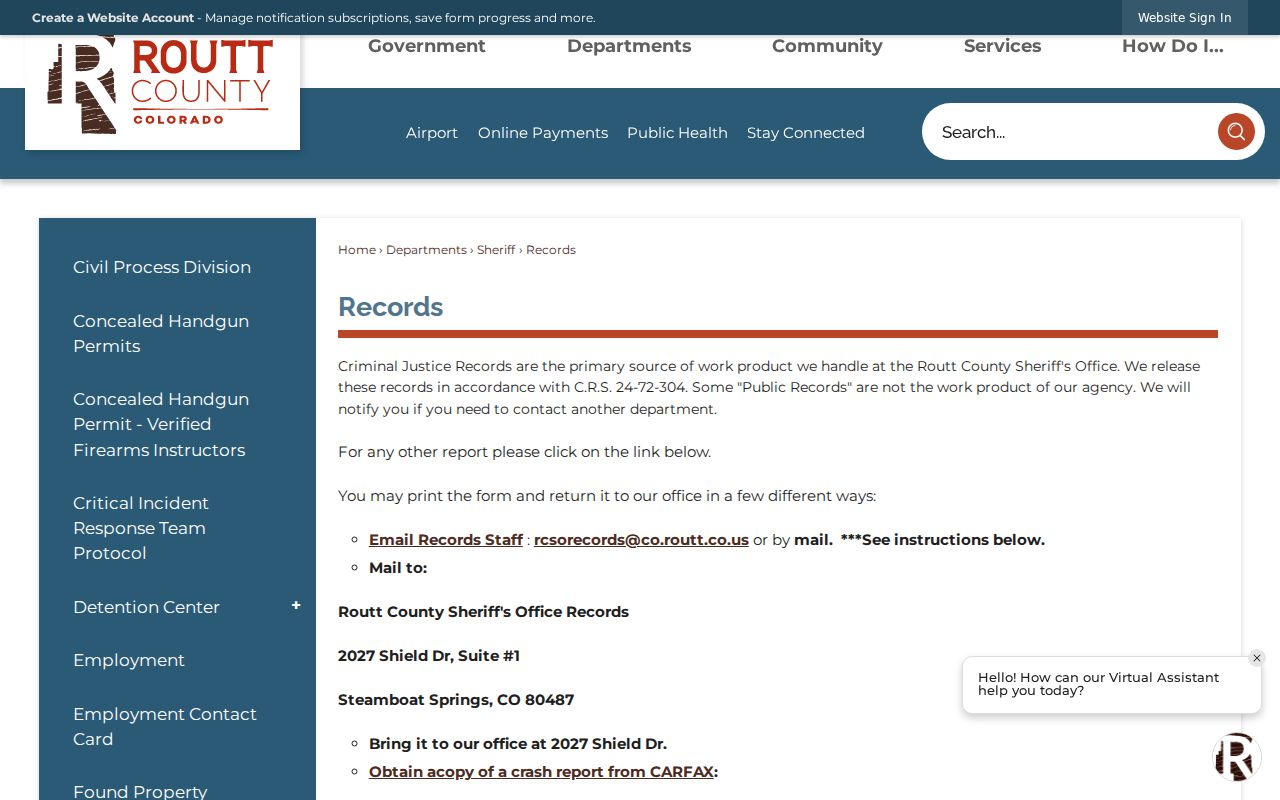
That records channel matters because a court docket may confirm that charges were filed, while the sheriff records process is the path for a law-enforcement report or other criminal-justice record not available through the docket tool.
How Charges Get Filed After an Arrest
After an arrest, a prosecutor decides what formal charges to file. In Routt County, that prosecution decision is handled by the 14th Judicial District Attorney's Office for state criminal cases. The DA serves Routt, Grand, and Moffat counties, and the Routt County office is at 1955 Shield Drive, Suite 201, Steamboat Springs. The court charge record starts when a charging document or related filing is accepted into the case file. Early docket entries may also show advisements, bond orders, and first appearances before a final charging decision is reflected.
| Complaint | Information | Indictment | |
|---|---|---|---|
| Filed By | Officer or prosecutor, depending on the case type | Prosecutor | Grand jury |
| Common For | Misdemeanors, traffic crimes, and initial criminal filings | Many felony prosecutions | Serious or grand-jury matters |
| Record Location | County Court or District Court case file | District Court criminal case file | District Court criminal case file |
The DA's local contacts are useful when the question is about prosecution status, victim and witness communication, or appointed-counsel issues. The public defender office serving Routt County is the Colorado State Public Defender in Steamboat Springs at 1955 Bridge Lane, Suite 2100, phone 970-879-0645.
Law Enforcement Records Before the Court Filing
The Sheriff's Office is at 2027 Shield Drive, Suite #1, Steamboat Springs, CO 80487. The sheriff page lists the general number as 970-879-1090, and the staff directory/front-desk number as 970-870-5503. Sheriff Doug Scherar is listed as the current sheriff. The Sheriff's Office has primary jurisdiction over unincorporated Routt County, Clark, Milner, Phippsburg, and Yampa, and it covers a county of 2,231 square miles. Steamboat Springs Police Department records may be relevant for city arrests or city enforcement events.
The Routt County Sheriff's Office directory identifies the official front-desk and command contacts.
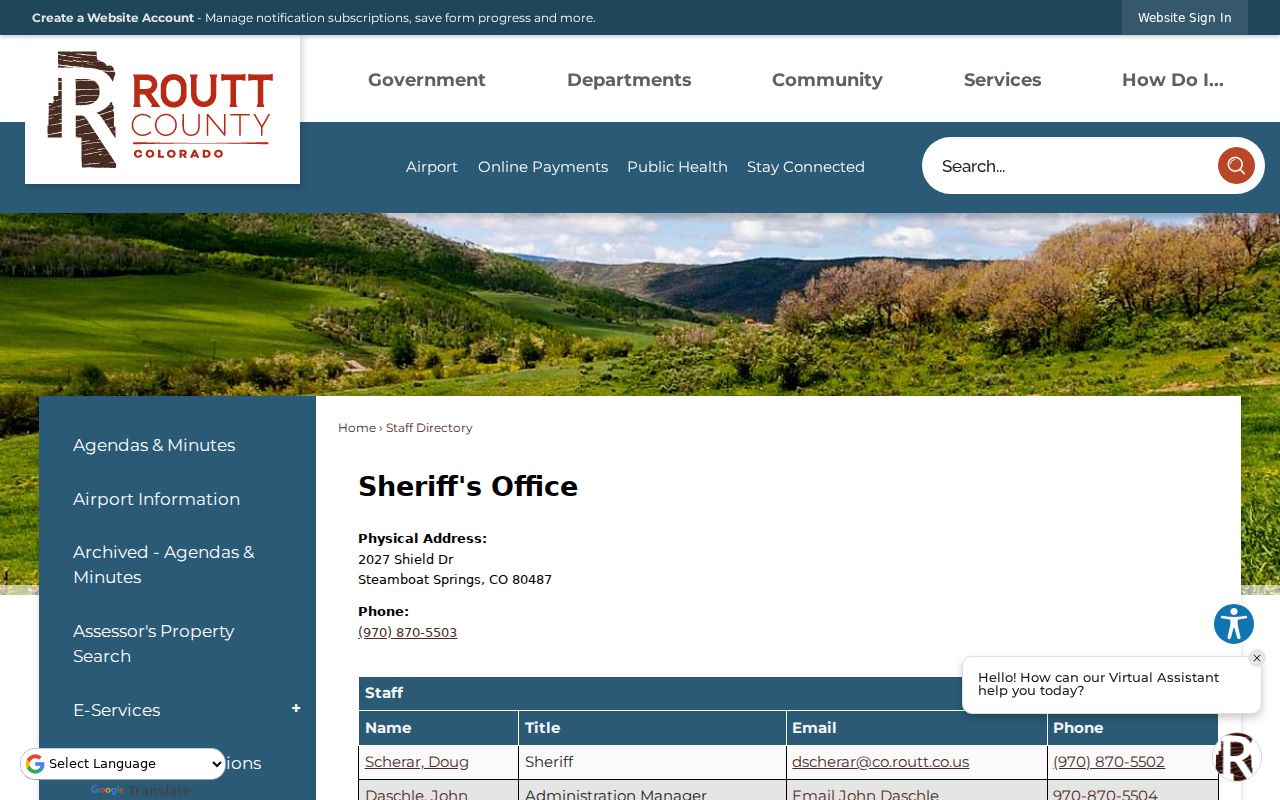
Use the sheriff directory when a request needs to be routed to the front desk, records staff, civil division, sheriff command staff, or detention contacts rather than the Clerk of Court.
The Steamboat Springs Police Department page is the city-level law-enforcement source for matters inside Steamboat Springs.
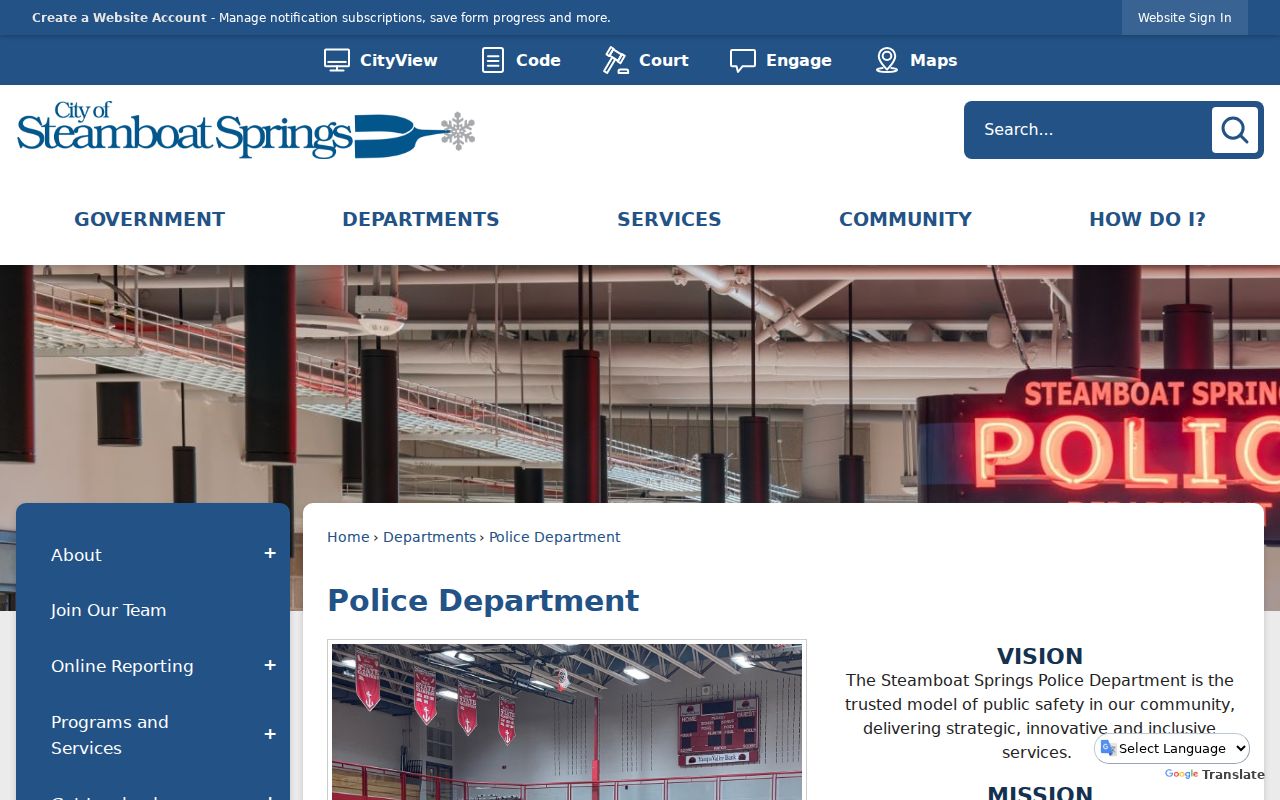
City police involvement does not automatically mean a state District Court case exists. Municipal-code and city traffic cases can route to Steamboat Springs Municipal Court, while state criminal charges route through County Court or District Court at Routt County Combined Court.
Charge Status and What It Means
Charges can change as a case moves through court. A person may be arrested on one suspected offense, advised on another, and later charged differently after the District Attorney reviews the evidence. A docket or register of actions may show status changes, but a copy of the charging document, order, plea paperwork, or disposition is the better source for exact charge language.
| Status | What It Means |
|---|---|
| Pending | The charge has not reached a final disposition and hearings, motions, plea discussions, or trial settings may still be active. |
| Amended or Reduced | The original charge was changed, often through prosecutor action, court order, or plea agreement. |
| Dismissed | The charge or case was ended by court action. The record may still show the filing unless sealed or otherwise restricted. |
| Disposition | The outcome of a charge, such as dismissal, plea, conviction, deferred judgment, sentence, or other final court action. |
Charges vs. Convictions
A charge is an accusation filed or listed after an arrest. A conviction is an outcome after a guilty plea, verdict, or other qualifying court disposition. Colorado docket and vendor records can show criminal case activity, but a name match or charge listing is not positive identification and does not prove conviction. CoCourts specifically warns that criminal index records may be limited and may represent only an arrest filing.
| Charge | Conviction | |
|---|---|---|
| Stage | Accusation or filed count | Final or qualifying outcome |
| Proof | Based on probable cause or prosecutor filing standards | Based on plea, verdict, or court finding |
| Where to Verify | Docket, charging document, sheriff report, or court file | Disposition, judgment, sentence, or certified court record |
Sealed vs. Expunged Records
Colorado public-access rules do not treat every criminal or juvenile record as open to ordinary public inspection. Juvenile-record availability is governed mainly by the Children's Code and court policy. Adult criminal record sealing depends on the charge, disposition, conviction type, waiting period, and later criminal history. Juvenile delinquency expungement under C.R.S. 19-1-306 can remove eligible juvenile records from ordinary access and treat them as not existing for many purposes.
| Sealed | Expunged | |
|---|---|---|
| Visibility | Removed from ordinary public access by statute or court order | Removed from ordinary use, especially for eligible juvenile records |
| Agency Access | May remain available to courts, prosecutors, law enforcement, or other authorized agencies | Very limited, subject to the governing statute and later court orders |
| Routt County Path | File through the court that handled the original case when eligible | Use Judicial Branch juvenile expungement procedures when eligible |
Charge Codes and Severity Levels
One arrest can lead to several separate charges. In Routt County, felony criminal cases are District Court matters, while County Court handles misdemeanors, criminal traffic, and some felony complaints or advisements before transfer. Docket search exposes case classes such as CR for criminal, T for traffic, and other labels including CV, DR, PR, JV, JD, and CW. Case numbers often use a four-digit year, a case class, and a sequence number.
Charge severity affects the court path, possible bond conditions, future hearings, and who can answer questions. The Clerk of Court can help with case records and copies, but the clerk does not give legal advice or negotiate charges. The DA controls prosecution decisions, and appointed-counsel eligibility goes through Colorado State Public Defender resources.
Public Access Rules for Criminal Justice Records
Sheriff criminal-justice records are released under the Colorado Criminal Justice Records Act, including C.R.S. 24-72-304. General state and local public records are governed by the Colorado Open Records Act, C.R.S. 24-72-201 to 24-72-309, unless a more specific rule applies. Court public records are governed by Chief Justice Directive 05-01 and Colorado court public-access rules. These systems overlap, but they do not use the same custodian.
For electronic sheriff records requests, Routt County requires the appropriate form, a copy of ID or a notarized form, and payment of applicable fees. The Sheriff's Office states that records may be mailed or sent through Evidence.com. Inspection is generally available within three business days under state statute, though request volume, redaction time, or other extenuating circumstances may add time.
Background Check Considerations
Casual court and sheriff lookups should not be treated as a consumer background check. A docket may show a charge without the underlying document. A sheriff record may document an arrest without proving a conviction. A vendor register of actions may show limited court data without case-document copies. Anyone making employment, housing, credit, insurance, or other regulated decisions should use legally compliant screening procedures rather than a public-records browse.
Important: This privately operated site is not a consumer reporting agency and cannot be used for FCRA-regulated screening decisions.
Restricted Charge Records in Routt County
Some charge records will not appear in ordinary public searches. Juvenile delinquency matters, adoption-related records, mental-health cases, sealed cases, expunged juvenile records, protected victim information, and private identifiers may be withheld or redacted. Search warrants can be sealed before execution or while an investigation remains active. Protection-order files may contain both public and confidential components, especially when safety-related information is involved.
When a case does not appear online, that does not prove that no record exists. It may mean the record is restricted, the search terms are incomplete, the matter is municipal rather than state court, or the document must be requested from the court or sheriff rather than viewed online.