
Routt County Probate Court
Probate in Routt County is a District Court function at Routt County Combined Court. Colorado District Courts hear probate matters, and the local court is the filing and records office for Routt County probate case files. The Colorado Judicial Branch staff page lists Carmma Parkison as Clerk of Court, Jury Commissioner, Water Clerk, and Probate Registrar for Routt County. That probate-registrar role is important because it confirms that estate filings are handled through the court clerk structure, not through the Clerk and Recorder.
Probate case records can include wills, petitions, applications, letters, orders, notices, inventories, accountings, and closing papers. They may also include guardianship and conservatorship filings. Some filings are public court records. Others contain protected personal, financial, medical, or minor-related details and may be restricted, redacted, or available only by court order.
The Routt County judges and staff page identifies the local Probate Registrar and other court officials.
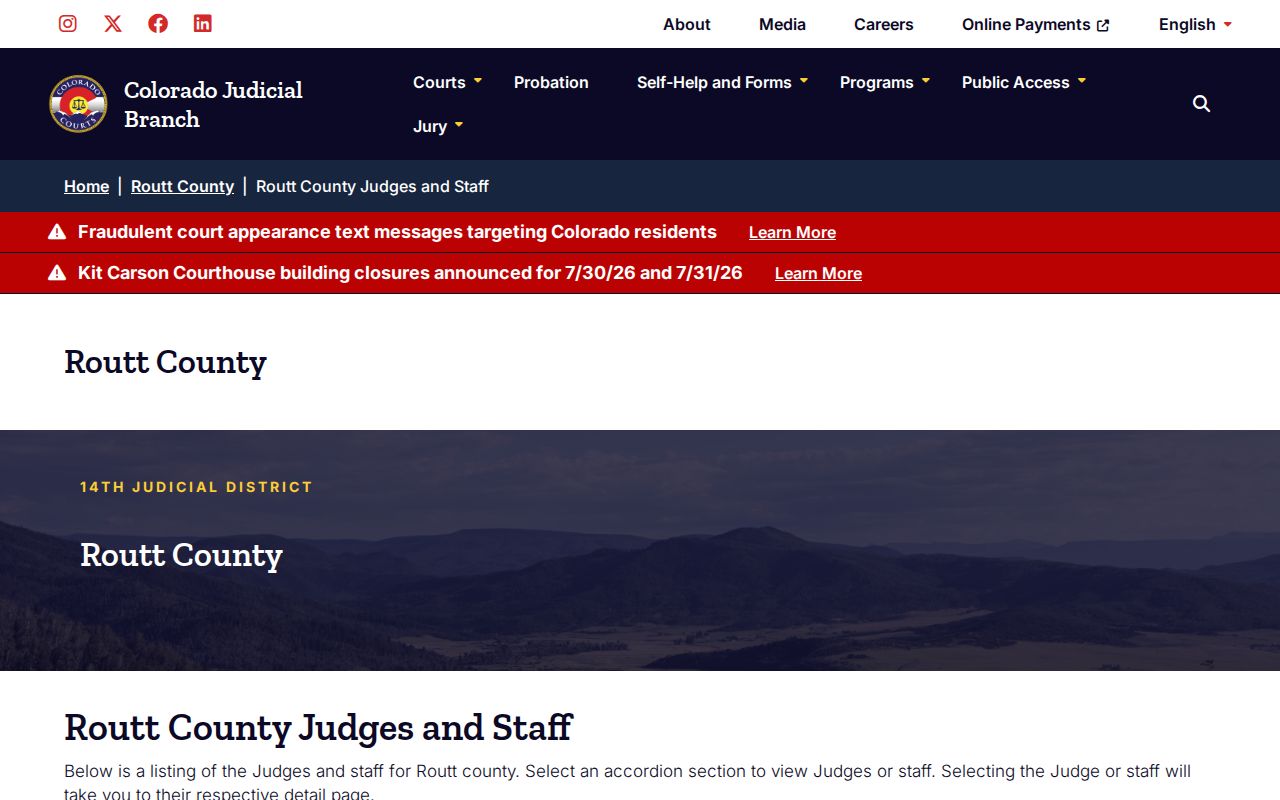
That staffing source ties Routt County probate records to the Combined Court's District Court operation.
Probate Terms Defined
Probate records use court terms that are easy to misread. A short glossary helps separate the person who died, the person who handles the estate, and the records that prove court authority. These terms appear in estate files, guardianship records, conservatorship records, and court orders.
- Testator
- The person who made a will.
- Executor
- The person named in a will to carry out estate duties, often called a personal representative in Colorado practice.
- Intestate
- A death without a valid will, which can require distribution under state law.
- Guardianship
- A case about personal care or decision-making for a minor or incapacitated person.
- Conservatorship
- A case about managing money or property for a person who cannot manage those assets alone.
- Letters
- Court-issued proof that a personal representative has authority to act for the estate.
Search Routt Probate Dockets
Start with the Colorado Judicial Branch Docket Search. Select the 14th Judicial District or Routt County, then select Routt County Combined Court if using the courthouse filter. Use Court Type District because probate is handled by the District Court function. If the case number is known, case class PR is the probate option visible in the docket-search case class list.
When the case number is unknown, search by decedent name, protected person name, or other party name. The docket tool may confirm that a probate case exists and may show court events, but it is not a complete document repository. If a docket confirms the case and copies are needed, use the Judicial Branch records request form or contact Routt County Combined Court at 970-879-5020 or routtclerk@judicial.state.co.us.
- Open the Colorado Judicial Branch Docket Search.
- Select 14th Judicial District, Routt County, or Routt County Combined Court.
- Choose District Court for probate matters.
- Use PR when searching by case-number parts.
- Search by person name when the case number is not known.
- Request copies from the court if the docket confirms the file.
Routt Probate Record Types
Estate files can begin with an application or petition and may include a will if one exists. Once the court or registrar authorizes a personal representative, the file may contain letters testamentary or letters of administration. Later filings may include creditor notices, claims, inventories, appraisals, accountings, distribution papers, and orders approving or closing the estate. Trust-related filings may appear if a trust dispute or court action is filed.
Guardianship and conservatorship records are also probate-category records in the District Court system. Guardianship petitions and orders focus on personal care and decision-making. Conservatorship petitions and orders focus on assets and financial management. Minor estate matters may be filed when a minor has property or settlement funds that need court oversight.
| Record type | What it may show |
|---|---|
| Will admitted to probate | The will offered to the court and related admission order. |
| Application or petition | The requested probate process, parties, venue facts, and estate basis. |
| Letters testamentary or administration | Authority for the personal representative to act. |
| Inventory and appraisal | Estate assets and values, when required or filed. |
| Creditor notice or claim | Notice to creditors or claims made against the estate. |
| Guardianship or conservatorship order | Court authority and duties for care, decisions, assets, or reports. |
| Closing statement or final order | How the estate or supervised matter ended. |
Request Probate Copies
The Colorado Judicial Branch Access Guide to Public Records explains that court records such as case documents are requested through court channels. Online docket tools and vendor register-of-actions services do not supply full document copies. For Routt County probate records, the official custodian is the court where the probate file was created and filed. Contact the Combined Court or use the online court-record request process for plain or certified copies.
A probate record request should include the case number if known, the decedent or protected person's name, the approximate filing year, the requested document type, and whether a certified copy is needed. Certified copies are often needed for banks, title companies, asset transfer, or agency proof. If the case includes restricted materials, court staff may release only the public parts or may require a judge's order.
The Judicial Branch public-records access guide explains the difference between docket access, vendor register-of-actions access, and court document requests.
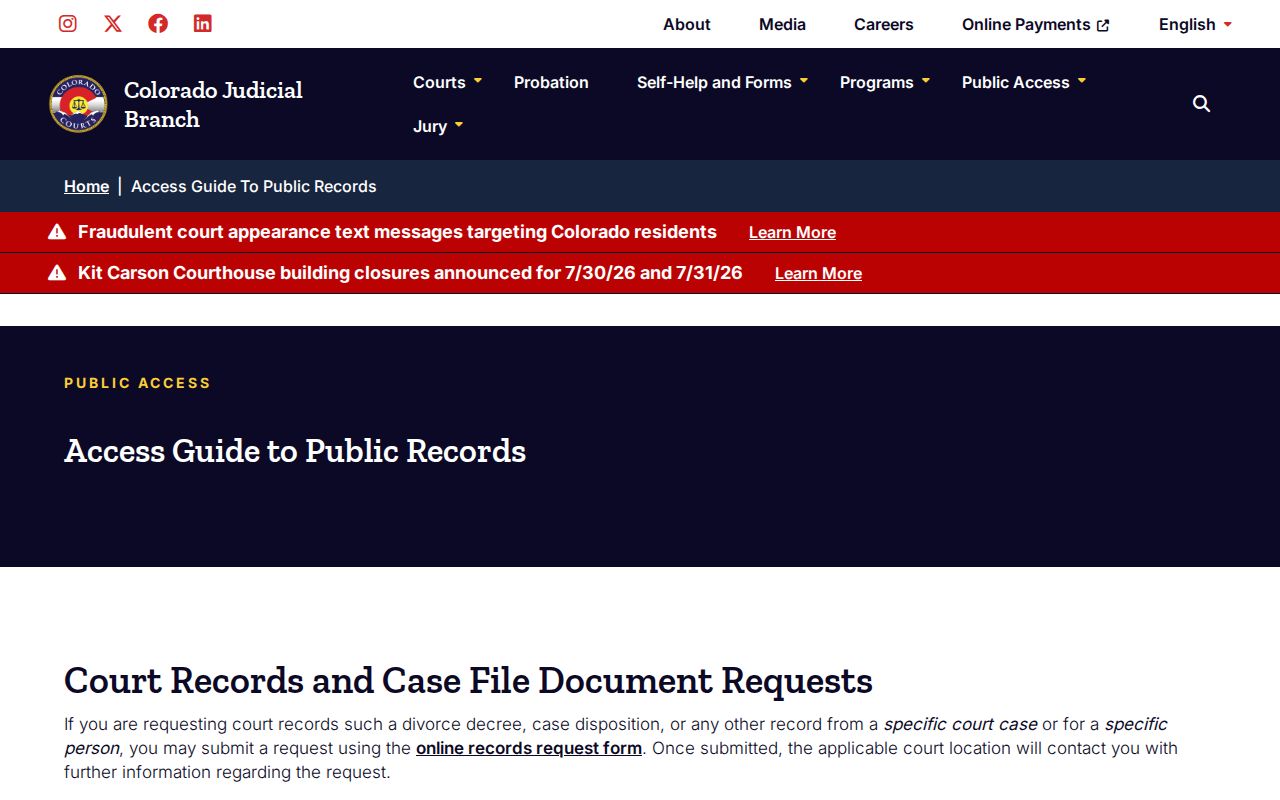
That access guide supports using the docket as a lead source while treating the court as the source for probate document copies.
Probate Registrar Contact
Routt County has one local state-court location for probate filing and records. The court's public counter hours are Monday through Friday, 9:00 a.m. to 1:00 p.m. and 2:00 p.m. to 4:00 p.m. Protection-order check-in has a separate security exception, but that exception is not a probate filing hour. For probate records, use the court phone or email before arriving with a copy request or filing question.
Routt County Combined Court
Probate Division of District Court
1955 Shield Drive, Unit 200
Steamboat Springs, CO 80487
970-879-5020
routtclerk@judicial.state.co.us
Public counter: Monday-Friday, 9:00 a.m.-1:00 p.m. and 2:00 p.m.-4:00 p.m.
Probate Filing Fees
Routt County-specific probate filing fees were not visible in the official sources inspected for the research file. Do not rely on an old fee list for estate, guardianship, conservatorship, copy, or certification costs. Confirm current probate filing fees with Routt County Combined Court before filing or ordering copies.
| Probate item | Fee instruction |
|---|---|
| Estate application or petition | Confirm current filing fee with Routt County Combined Court. |
| Letters testamentary or administration | Confirm copy and certification costs with the court. |
| Guardianship petition | Confirm current filing fee with the court before filing. |
| Conservatorship petition | Confirm current filing fee with the court before filing. |
| Plain or certified probate copies | Confirm current copy charges with the court records office. |
How Probate Works
A Routt County probate filing starts by deciding whether probate is required and which Colorado process applies. Assets, title status, estate size, disputes, and whether a will exists all affect the path. If Routt County is the proper venue, the filing goes to the District Court probate function at Routt County Combined Court. The initial packet may include the will, petition or application, death and heir information, and proposed appointment documents.
The court or probate registrar reviews filings, issues letters when appropriate, and sets hearings when a formal probate, contested matter, or judicial decision is required. A personal representative gathers assets, gives required notices, handles creditor claims, files inventories or accountings when required, and distributes assets under the will or Colorado intestacy rules. Closing papers or final reports end the estate when the process is complete.
Guardianship and conservatorship cases require more ongoing court oversight. These matters can involve incapacity, best-interest findings, notices, reports, accountings, and later modification or termination orders. Because those files often contain health, care, or money details about a living person, access is more limited than for many estate docket entries.
Restricted Probate Details
Probate files are generally court records, but public access has limits. Protected personal identifiers, financial-account numbers, medical evaluations, incapacity records, minor information, and sealed materials may be withheld or redacted. A register of actions may show that a case exists without showing the contents of a will, inventory, medical report, or protected order.
Juvenile and adoption-related materials are governed by separate confidentiality rules and should not be treated like ordinary estate files. Mental health records are also restricted because they can include treatment and medical information. If a probate docket appears incomplete, that may reflect a legal access limit rather than a missing record.
Access note: Ask the court which parts of a probate file are public before ordering copies that may include guardianship, conservatorship, minor, or medical information.